
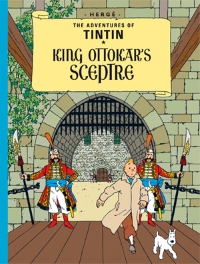
King Ottokar's Sceptre
This adventure begins with a briefcase left on a park bench in Brussels. The case belongs to Professor Alembick, a sigillographer (a specialist in the study of stamps and wax seals). Doing his good deed for the day, Tintin returns the briefcase to the professor, and it is not long before he joins Alembick on a trip to Syldavia!
Upon his arrival in the Balkans, Tintin begins to uncover a plot aimed at dethroning King Muskar XII, the ruler of Syldavia. In Syldavian tradition, the king maintains his power by presenting the royal sceptre of his ancestor, King Ottokar, to his people on Saint Vladimir’s Day each year. Fascist plotters plan to steal the sceptre and force the king to cancel the traditional ceremony, which would create political instability.
The plotters are working for the interests of Borduria, a neighboring country determined to annex Syldavia. The mastermind of the plot is a certain Müsstler. In true Tintin-fashion, our hero undertakes to recover the stolen sceptre and foil the coup.
About the Adventures of Tintin Series
Books in series order
- 1.Tintin in the Land of the Soviets(1929)
- 2.Tintin in the Congo(1930)
- 3.Tintin in America(1932)
- 4.Cigars of the Pharaoh(1934)
- 5.The Blue Lotus(1935)
- 6.The Broken Ear(1937)
- 7.The Black Island(1937)
- 8.King Ottokar's Sceptre(1939)
- 9.The Crab with the Golden Claws(1941)
- 10.The Shooting Star(1942)
- 11.The Secret of the Unicorn(1943)
- 12.Red Rackham's Treasure(1945)
- 13.The Seven Crystal Balls(1948)
- 14.Prisoners of the Sun(1949)
- 15.Land of Black Gold(1950)
- 16.Destination Moon(1953)
- 17.Explorers of the Moon(1954)
- 18.The Calculus Affair(1956)
- 19.The Red Sea Sharks(1958)
- 20.Tintin in Tibet(1960)
- 21.The Castafiore Emerald(1963)
- 22.Flight 714(1968)
- 23.Tintin and the Picaros(1976)
- 24.Tintin and Alph-Art(1986)
Reading age: 8+ years
Clever and ever-curious, Tintin is a reporter-turned-detective whose pursuit of villains, criminals, treasure and the occasional hostorical artefact takes him all over the world. Join Tintin and a colorful cast of friends, including his faithful dog Snowy, Captain Haddock, absent-minded Professor Calculus and the Twins, as they embark on an extraordinary adventures spanning historical and political events, fantasy and science-fiction adventures and thrilling mysteries. These full-color graphic novels broke new ground when they were first released and became the inspiration for countless modern-day comic artists. . Belgian-artist Hergé based his stories on real-world events and cultures that had caught the Belgian national attention—from space exploration to Arab oil wars—and brought them to life for his readers in inspiring and exciting ways.
The series was one of the most popular European comics of the 20th century, and it remains popular today. By the time of the centenary of Hergé's birth in 2007, Tintin had been published in more than 70 languages with sales of more than 200 million copies worldwide.