
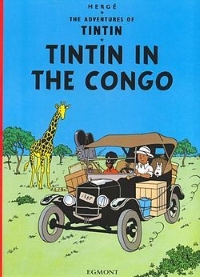
Tintin in the Congo
In Tintin in the Congo, Tintin and Snowy travel to central Africa to report on the situation in the Belgian Congo. Upon arrival, the duo gets pulled into a variety of adventures, encountering wild animals, angry natives and American diamond smugglers controlled by infamous mobster Al Capone.
With the help of a Congolese boy, Coco, Tintin works to improve the lives of the local population, despite close calls with crocodiles, lions, monkeys and all kinds of exotic wildlife. It is not long before he begins to uncover a sinister criminal organization exploiting the Congo for financial gain. Not only does Tintin have to watch his back to make sure the bad guys don’t trap him, but he also has to work to convince some of the locals of his good intentions. This means going up against the tribal witch doctor, who is in secret allegiance with Al Capone’s henchman. If he wants to survive this adventure, Tintin really has to stay on his toes!
Please Note: First published in book form in 1931 (in black & white only), Tintin in the Congo reflects the colonial attitudes of that period in its depiction of African people and its content may be considered controversial for a modern audience.This is also true of the treatment of big-game hunting and the attitude towards animals. Herge himself admitted that he was influenced by the racial and cultural stereotypes of the period.
About the Adventures of Tintin Series
Books in series order
- 1.Tintin in the Land of the Soviets(1929)
- 2.Tintin in the Congo(1930)
- 3.Tintin in America(1932)
- 4.Cigars of the Pharaoh(1934)
- 5.The Blue Lotus(1935)
- 6.The Broken Ear(1937)
- 7.The Black Island(1937)
- 8.King Ottokar's Sceptre(1939)
- 9.The Crab with the Golden Claws(1941)
- 10.The Shooting Star(1942)
- 11.The Secret of the Unicorn(1943)
- 12.Red Rackham's Treasure(1945)
- 13.The Seven Crystal Balls(1948)
- 14.Prisoners of the Sun(1949)
- 15.Land of Black Gold(1950)
- 16.Destination Moon(1953)
- 17.Explorers of the Moon(1954)
- 18.The Calculus Affair(1956)
- 19.The Red Sea Sharks(1958)
- 20.Tintin in Tibet(1960)
- 21.The Castafiore Emerald(1963)
- 22.Flight 714(1968)
- 23.Tintin and the Picaros(1976)
- 24.Tintin and Alph-Art(1986)
Reading age: 8+ years
Clever and ever-curious, Tintin is a reporter-turned-detective whose pursuit of villains, criminals, treasure and the occasional hostorical artefact takes him all over the world. Join Tintin and a colorful cast of friends, including his faithful dog Snowy, Captain Haddock, absent-minded Professor Calculus and the Twins, as they embark on an extraordinary adventures spanning historical and political events, fantasy and science-fiction adventures and thrilling mysteries. These full-color graphic novels broke new ground when they were first released and became the inspiration for countless modern-day comic artists. . Belgian-artist Hergé based his stories on real-world events and cultures that had caught the Belgian national attention—from space exploration to Arab oil wars—and brought them to life for his readers in inspiring and exciting ways.
The series was one of the most popular European comics of the 20th century, and it remains popular today. By the time of the centenary of Hergé's birth in 2007, Tintin had been published in more than 70 languages with sales of more than 200 million copies worldwide.